
Evictions and Housing Court
Get the information, tools, and support you need to understand your rights as a New York City tenant.
Nonpayment Evictions
Holdover Evictions
Finding a Lawyer
Illegal Evictions / Illegal Lockouts
Court Without a Lawyer
Good Cause Evictions Defense
One-Shot Deals
What is a nonpayment proceeding?
In a nonpayment proceeding, the landlord claims that you owe rent. If the landlord wins, the court will award what are known as a money judgment and a judgment of possession (or “possessory judgment”). A money judgment permits the landlord to go after any assets you might have, such as bank accounts or your salary, to collect what is owed. The possessory judgment means that if you do not pay the amount determined by the court, the landlord can request a warrant of eviction and have a city marshal remove you from your home. If you pay the money judgment on time, the possessory judgment is satisfied and you cannot be evicted.
Can my landlord evict me or hire a marshal to evict me without first taking me to court?
No. A landlord in New York City can legally evict a residential tenant only by obtaining a judgment of possession from a court and then having a marshal apply for a warrant of eviction. An actual, physical eviction can legally happen only after the tenant has been given notice of the court proceeding and an opportunity to come to court to present a defense. It is illegal for a landlord to force a residential tenant out by other methods, such as by changing locks or cutting off services.
What must happen for my landlord to bring a nonpayment of rent case in court?
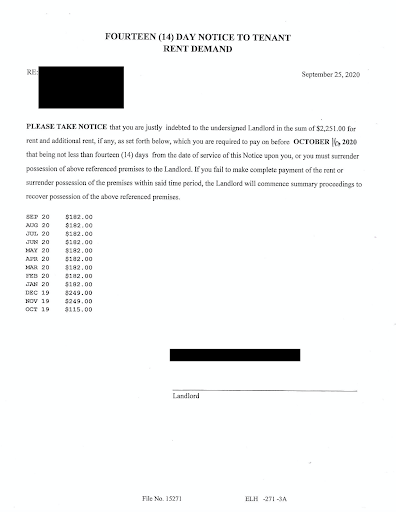
- Your landlord must demand that the rent be paid, how much rent is owed, and that if not paid, that you will be evicted. This notice must be written and fourteen days after your rent is due.
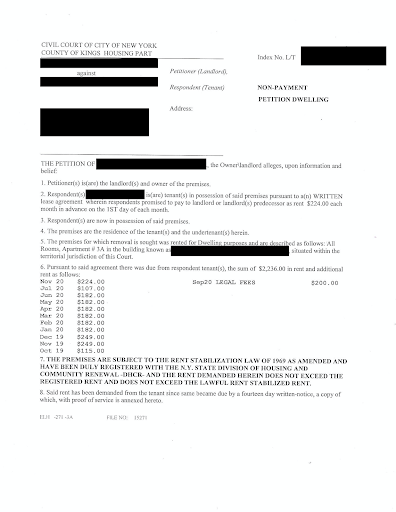
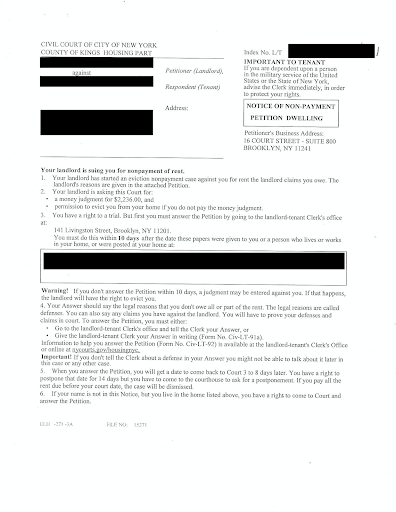
- After you receive the fourteen day written demand for the rent, your landlord may file a nonpayment proceeding at Housing Court and serve papers on you. The court will also mail a notice of the court proceeding, directing you to answer the petition within ten business days.
- You must answer the petition in person at the Housing Court Clerk’s office. The Clerk will then give you a court date.
- On the court date, you have the opportunity to present defenses to a Housing Court Judge. However, in many cases, tenants and landlords meet in the courthouse and sign an agreement called a ‘stipulation’. You have both options, and there are advantages and pitfalls to both. As a general rule, tenants are cautioned against signing anything they do not understand. Consult an attorney whenever possible when eviction proceedings are concerned, and if this is not an option, to talk to an experienced tenant advocacy organization, seek out resources and help, and educate yourself.
Note: If you pay within the time allowed, your landlord should not proceed with the case, but you receive papers directing you to appear in court even though you don’t owe money, you should go to court. Your failure to appear will result in a default judgment in favor of your landlord – meaning, that your landlord will win the right to evict you from your apartment and collect the money that he/she claims you owe.
How is my landlord supposed to serve me eviction papers?
If your landlord files papers in the court to begin a nonpayment proceeding, the landlord is required to have the court papers “served on” (delivered to) you in one of these ways:
- By having someone not involved in the case (usually a process server) hand you the court papers personally,
- By having someone not involved in the case hand the papers to an adult (over 18) who lives or works in your home, and also mailing them to you by certified and regular mail.
- If you are not home, by taping the papers to your door or slipping the papers under your door , and then also mailing them to you by certified and regular mail
What do I do when I receive paperwork from the court?
When you are served with a nonpayment petition by the landlord, you have ten days to answer it in court. It is best to prepare a written answer, explaining your side of the story. Make three copies and mail one to the landlord’s attorney, file one in court, and keep one for your records. You can also state your answers to the clerk in the housing court, but before leaving the clerk’s window, check the answer form to make sure that everything you said was marked on the paper.
What if I cannot make it to court to file an answer? Can someone go on my behalf?
You should make every effort to answer in person if possible. Answering in writing or sending someone to answer in your place is not ideal.
The courts have said that only the person named on the petition can answer. If that person is unavailable, there is a Certificate of Unavailability, and there are also instructions for answering in writing.
Some advocates have seen cases where people other than the named tenant are permitted to answer by the clerks, but on the return date, they are not permitted to defend the case unless they have written authorization from the Respondent.
How can I get a free lawyer to defend me?
All tenants in New York City who earn less than 200% of the poverty line, regardless of where you live in the city or your immigration status. If you earn more than 200% of the poverty line you may still qualify.
You should be assigned attorneys at your hearings if they appear virtually (by phone or video conference) or in person. If you have a notice Call 311 and ask for the Tenant Helpline.
If you are a member of a union, you may have access to free legal services via your union.
What if I can’t get a lawyer before my court date?
You have the right to ask and get at least one adjournment. As in the case of holdover, a judge must give at least one 14-day adjournment if you ask. Additional adjournments are not automatic.
You can ask the court to assign you counsel. Let the judge know that you need help finding counsel and that you need the court to help. Let the court know if you are a senior (60 years old or over) or have a disability.
I heard that most tenants in nonpayment of rent evictions don’t go to trial, but instead they sign a stipulation (an agreement with the landlord). How does that work, and what should I be careful about?
There is a tremendous amount of pressure placed on tenants to settle nonpayment cases by signing an agreement or contract known a stipulation. Even your judge may pressure you to sign a stipulation, in part because the housing courts are so overwhelmed with cases. Unfortunately, tenants are usually at a disadvantage when negotiating stipulations, this is changing due to the Right to Counsel. If you are low-income and live in certain zip codes you may have the right to a lawyer.
Stipulations are signed by the judge and become a binding court order between the landlord and tenant. You are not required to settle the case, and it will be up to you to decide whether it is in your interests to do so.
It is very dangerous to sign a stipulation requiring you to do something that you are not positive you will be able to do, such as pay a certain amount by a specific date. A tenant can face several consequences if they agree to do, something they cannot comply with. Many people have been evicted because the unnecessarily agreed to overly optimistic amounts and dates. This is because the agreements, as written up by landlords’ attorneys, frequently say that if the money is not paid by the agreed date, the landlord can enter a judgment and obtain a warrant of eviction.
Do not sign an agreement that has language and provisions you are not comfortable with, or that you do not understand. You have the right to negotiate over the language of any stipulation, and to object to any provision. You may have more leverage than you realize, because often the landlord wants to settle the case and will compromise with you if you stick to your guns. You can also ask the judge, or their law assistant, to help work out an agreement.
Keep in mind is that in a nonpayment of rent eviction case, your landlord cannot evict you if you pay what is ordered by the court, or agreed to in court, on time. In many instances, the issue is just that tenants need more time to come up with the money. Sometimes the amount of money owed is in dispute, and tenants simply need to come up with proof that they don’t owe the amount being demanded by the landlord. Decide what you need, and what will work for you. That will help you determine whether it’s in your interest to sign a stipulation, and if so, what the stipulation should say.
Use the resources available to you inside the housing court. Every housing court has a pro-se attorney’s office, located in what is sometimes called the “resource room”. Also, a nonprofit agency called Housing Court Answers staffs information tables in the housing courts. As a last step, you can tell the judge that you aren’t entirely sure what the stipulation means and what the consequences are, and him/her to explain what the stipulation means in plain language before it is signed.
What will happen if I end up going to trial in my nonpayment of rent case?
If the case is not settled or withdrawn by the landlord, it will go to trial. If you are unable to obtain a lawyer, you will be at a certain disadvantage. However, there are things you can do to help you be heard. Be confident and organized. Think about what the issues in the case are likely to be, and how you intend to prove your side. Photographs, witnesses, letters and other documents will be useful. The judge, or the clerk’s office, should answer your questions about how to subpoena any records you feel are necessary.
How can I defend myself in a nonpayment of rent case in housing court?
Common defenses about the rent being demanded:
- Were you given a fourteen-day notice before receiving Court papers?
- Did the landlord refuse to take your rent?
- Is the amount of rent being claimed by the landlord incorrect? The rent being claimed may be incorrect because it is not the legal registered rent. (This applies to rent-stabilized and rent-controlled apartments. To find out the legal registered rent or rent history for your apartment, you can contact the Division of Housing and Community Renewal in your borough.)
- Is this for anything other then the rent on your lease? (This amount can not include fees)
- Is the monthly rent being claimed different from the amount in your lease?
- Has the rent been partially or fully paid?
Common defenses about the condition of the apartment:
- Are there conditions in your apartment, which need repair or services that are not being provided?
- Are you receiving public assistance and there are Housing Code violations in your apartment or building?
- Are you living in an illegal apartment? An illegal apartment is one in which the landlord does not have a valid Certificate of Occupancy from the Department of Buildings.
- Other common defenses:
- Did you pay for repairs, utilities, or services, that should have been provided by your landlord?
- Has your personal property been damaged because your landlord failed to provide proper repairs or services?
- Do you have any other reason(s) for believing that you do not owe the landlord some or part of the amount being claimed?
- Does the rent demand and petition accurately state for which months you owe rent?
If your answer to any of these questions is yes, you might want to put in a counterclaim. A counterclaim is a specific amount of money that you feel the landlord owes you. You should have receipts to support any counterclaims you may make. Please be sure to briefly state the reason(s) for counterclaim and the specific dollar amount being claimed.
What if I simply cannot afford the rent?
Your inability to afford the rent is not a defense. You may be able to raise defenses about why you do not owe the amount being demanded. For rent you do owe, you also may be able to work out a payment plan with the judge, or with the landlord or the landlord’s attorney. You will need to find a way to pay rent that you do owe to stop the eviction. Payment plans are very common, but there are dangers in signing a settlement agreement – called a stipulation – if you don’t have the advice of a tenant attorney or an experienced tenant advocate. Many tenants sign papers that they don’t completely understand, unknowingly agree to terms that harm them, and unnecessarily give up rights that they have. There are limited resources available to provide rental assistance to low-income tenants, and to provide one-time assistance to tenants to help them avoid an eviction. Read our page on tips if you just can’t afford the rent.
Can I raise the fact that I have not gotten repairs or services as a defense?
Your landlord’s failure to make necessary repairs or provide necessary services is a valid defense for nonpayment of rent. Withholding rent, for this reason, is legal, though it does carry consequences that you should consider – including ending up on the tenant blacklist, or even eviction if you fail to show up to your court date and the landlord gets a default judgement. Please read these considerations in deciding whether to withhold rent, and don’t spend the money – you may have to pay some or all of the rent back.
A tenant’s defense to a nonpayment proceeding based on the lack of repairs is called the affirmative defense of breach of the warranty of habitability. In plain English, this means the landlord broke his legal obligation to keep the apartment in good repair or provide required services like heat and hot water. Be specific in your answer about the unsafe or unhealthy conditions in your apartment, about the landlord’s knowledge of them, and about how long they have existed. If you prove this defense, the court may give you a credit against any rent owed, and will order the landlord to correct any remaining violations. It is important to ask for an inspection when you first answer the petition, and it is also usually a good idea to take photographs of the conditions. The amount of a rent abatement (deduction from the amount you owe) is up to the judge, so don’t count on a particular amount. You can also reach an agreement with the landlord that addresses the conditions in the apartment. Prepare yourself by reading about housing court stipulations.
What is a ‘General Denial’?
In order to succeed in his case against you, the law requires the landlord to prove their ownership of the building; what the lawful rent for your apartment is and that the building is properly registered with various city and state agencies. Often you will not have direct knowledge of whether or not these conditions are met. If your answer includes a general denial, the burden remains on your landlord to prove compliance with all of these conditions.
What if the rent being demanded includes rent from a long time back? What is latches/stale rent?
Sometimes after a building has been owned by many owners, or has been neglected a period of time, rent arrears may build before a tenant is taken to court. If you are prejudiced by being exposed to a possessory judgment for a large amount of rent because the landlord waited too long to start a case, you should claim ‘latches’, also known as ‘stale rent’ in your answer.
How can I dispute the amount that my landlord claims that I owe?
If you have specific information that the rent claimed is above the legal rent (in a rent-stabilized, rent-controlled, or subsidized housing unit), or that you have paid rent for some or all of the months claimed in the petition, you should say so in your answer. Bring documentation to prove your points (canceled checks or copies of money orders, etc.)
What to do if the amount owed is due to problems with a rental assistance program (Section 8, SCRIE, DRIE, or Public Assistance)?
If you fell behind in the rent because of problems obtaining Public Assistance, Senior Citizen Rent Increase Exemptions (SCRIE), Section 8 or other subsidies put it in your answer. The court will probably give you a reasonable amount of time to resolve these problems.
What if I need time to find a new place to live?
Judges may now stay an eviction for up to ONE YEAR. They must consider ill health, exacerbation of an ongoing condition, child’s enrollment in a local school, or any other extenuating life circumstance affecting the ability of the tenant and maintain quality of life, if you are forced to move.
If you pay the rent you owe at any time during this period, the eviction will be stopped.
Sample Documents Gallery
Legal Disclaimer:
The information contained on this web page does not constitute legal advice and must not be used as a substitute for the advice of a lawyer qualified to give advice on legal issues pertaining to housing. For more, visit our page on Finding a lawyer.
This information pertains only to tenants living in New York City.
Many of your rights depend on the type of housing you live in or your type of tenancy. You may be subject to different laws and have different sets of rights than even neighbors in your own building. Learn which rights and responsibilities apply to you.
Step 1
Step 2
Step 3
The Basics of Getting Repairs
The laws and regulations of New York require that your landlord maintain essential services in your building and apartment and that they make prompt repairs. However, to enforce these laws you must take action – no one will do it for you.
If you have notified your landlord, managing agent, or building superintendent, and they have not resolved the problem, you must take additional steps, which are outlined on this page.
Note: If you have problems getting repairs or services, chances are that your neighbors have these problems, too. Working with your neighbors on common problems is almost always more effective than fighting the battle alone. You may want to join your building’s tenant association, or if your building doesn’t have one, to start one. (Read more about Forming a Tenants’ Association.)
Step 1:
Send a letter to your landlord
It’s important to put your request for repairs or services in writing, even if you have already spoken to your landlord, managing agent, or building superintendent. In general, when fighting with your landlord over repairs and services, keeping good records is key.
Your letter should list all the problems in your apartment and in the common areas of the building, and include the history of all your previous attempts to get the problems solved – who you spoke to, what promises they made, and what was not done. If your apartment or building needs many repairs, and because it’s important to include everything that needs to be addressed in your first written communication, you may want to download and print our Tenants’ Inspection Checklist/Lista de verificación de la inspección de los inquilinos (公寓居住條件調查問卷) and use it as a guide so that you don’t leave anything out. Photocopy the checklist, keep a copy for your records, and send the checklist along with your letter to the landlord.
Particularly if you are in a rent-stabilized or rent-controlled apartment and plan to file a reduction in services complaint with NYS Homes & Community Renewal to get a rent freeze, you must be able to prove that you first wrote to your landlord notifying him/her of the problem. You must send the letter by certified mail, return receipt requested, and keep a copy of the letter, along with proof of mailing and the receipt, when it arrives, with your copy of the letter (along with the Tenants’ Inspection Checklist, if applicable) to show the HCR or a Housing Court judge, if you wind up going to court.
Here is a sample letter:
July 1, 2017
Dear Landlord,
Enclosed is my rent for July. As I have told the super several times, I need repairs in my apartment and in the public areas of the building. He keeps saying he will do them, but he never has. These repairs are:
Bathroom
1. Hot-water faucet in tub leaks
2. Floor tiles broken
Kitchen
3. Holes in the floor by the radiator
Common Areas
4. Entrance door lock defective
If these repairs are not made by July 15, 2017, I will have no choice but to use my legal remedies to get the repairs done. Please contact me as soon as possible to arrange a time to have these repairs made.
Sincerely,
Jane Doe (Apt. 4A)
daytime phone: 123-456-7891
A Sample Letter from a Tenant's Association:
July 1, 2018
Dear Landlord:
We write to you as members of the XYZ Tenants’ Association in order to get repairs to the public areas and our individual apartments. Previous attempts by individual tenants to get repairs made have failed. We intend to act as a tenants’ association from here on, and take whatever follow‐up steps are necessary to get these repairs.
We have attached to this letter a list of repairs needed in various apartments. In the public areas, the following needs to be repaired:
- The entryway door lock is defective: outsiders can easily gain entrance to the building by pushing hard on the door.
- The elevator does not stop level with the floors.
- The hallways are in need of cleaning and mopping.
If these repairs are not made by July 15, we will exercise our legal rights to get them done. Please contact us as soon as possible to set up a schedule for making repairs.
Sincerely,
Jane Doe (Apt. 4A), Robert Smith (Apt 5B)
Co‐Presidents, XYZ Tenants’ Association
Be prepared to follow up with a complaint to the city or state housing agencies, and/or a court action. If your landlord does not respond to your letter, or responds but does not do the work (or doesn’t complete the job) you should think about the next steps.
This is a paragraph. Writing in paragraphs lets visitors find what they are looking for quickly and easily. Make sure the title suits the content of this text.
Add your title here


Step Two:
File A Complaint With Government Agencies
You can file a complaint with the city by calling 311 from any phone in New York City (from outside NYC, call 212‐639‐9675). Through 311, you can reach city departments responsible for enforcing the housing, building, and health codes, and ask for an inspection.
The Dept. of Housing, Preservation and Development (HPD) enforces laws relating to housing maintenance (heat, hot water, lead paint, leaky ceilings, other apartment deficiencies).
The Dept. of Health & Mental Hygiene (DOH) deals with lead poisoning prevention (together with HPD), child window guard requirements, rodent and pest infestations, and some mold and asbestos conditions.
- The Dept. of Buildings (DOB) issues permits for new construction and for alterations or renovation to existing buildings, inspects elevators, plumbing, and electrical systems, and responds to complaints about unsafe structures.
- The Dept. of Environmental Protection (DEP) handles complaints about noise and odors (produced by businesses such as restaurants and clubs).
- Note: Always call 911 for emergencies (a cascading flood, a gas leak, carbon monoxide alarms sounding, etc).
- If you are in a rent-stabilized or rent-controlled apartment, you can file a complaint (either building‐wide or for your individual apartment) with the state housing agency, Homes & Community Renewal (HCR)
Individual tenants should use HCR’s form RA-81 “Application For A Rent Reduction Based Upon Decreased Service(s) – Individual Apartment” and tenant groups should use form RA-84 “Application For A Rent Reduction Based Upon Decreased Building-Wide Service(s)”. HCR can be reached by calling 833-499-0343 if you would like the forms mailed to you or go online to download any of HCR’s forms for tenants.
Tenants can now report emergency and non-emergency conditions online through DHCR: Online Decreased Services Application
You can also obtain copies of the forms by visiting HCR’s borough offices
HCR has the power to order a rent reduction and rent freeze for rent-regulated apartments until the landlord fixes the problem. If the problem is no heat or hot water, you can file once you have a copy of a violation report from a city agency. For all other issues, you must first write a letter to your landlord complaining about the problem and send it by certified mail, return receipt requested. You can file with HCR once 10 days – but no more than 60 days – have passed since sending the letter to your landlord. In the letter and on the forms, be specific in identifying the problem. For more on the process of applying for a rent reduction, read HCR’s Fact Sheet #14: Rent Reductions for Decreased Services.
Be advised that while HCR rent reductions and rent freezes may be an incentive for your landlord to make repairs, HCR cannot force such repairs to be made, and the agency typically acts slowly. It’s generally advisable to file a rent reduction and also take other steps (such as suing your landlord in court in an HP Action for repairs and services). Requesting a rent reduction from HCR does not prevent you from also pursuing other remedies.
What happens after I file a complaint with a city agency?
Does the violation get corrected?
In theory, when tenants file complaints with city agencies, the agency will send an inspector and levy fines against landlords for violations that are not fixed. However, in many cases, tenants must be persistent to get an inspection and must take additional steps to force their landlords to make the repairs, including taking the landlord to court.
You can check violations on HPD’s section of the city’s website: nyc.gov/hpd
When you call 311, always ask for and get the complaint number. Call a local elected official to help with follow-up (use these links to look up your New York City Council member, New York State Assemblymember, New York State Senator, Borough President, or Public Advocate.) When calling 311 about a building‐wide condition, get all the tenants in the building to call every day until the problem is fixed.
Once a violation is issued, your landlord will be given a time frame to correct the violation, based on the severity of the condition. However, the city often does not do adequate follow-up, and some landlords simply ignore violations. If that happens, you can sue your landlord for repairs & services in Housing Court, in a case called an HP Action.
Step Three:
Sue your landlord in Housing Court (HP Action for repairs and services)
Tenants may start a lawsuit against their landlords, either individually or as a group of tenants from the same building, based on their landlord’s failure to make repairs or to provide essential services. The procedure is fairly simple and has a good chance of success.
Go to the Housing Court in your borough and ask for paperwork to start a Housing Part (HP) Action. You can get help in filling out the forms at the clerks’ windows, the Court Help Center, or Housing Court Answers, a nonprofit organization that staffs information tables in the Housing Courts.
There is a fee for starting a case, but if you have a low income, you can ask for the fee to be waived. Once you file the forms with the clerk, you will be given a court date and an inspection date. You will have to serve your landlord and the city with a copy of the papers. The clerk will instruct you on how to serve the papers. Be sure to follow the instructions carefully. Also, be sure that you are at home on the date of the inspection and that you return to court on the date and at the time specified, or your case will not be successful.
Prepare for your court date. Print out the list of violations for your building and apartment from HPD’s website: nyc.gov/hpd. Take new pictures of any violations that can be seen. On the date of your hearing, take to court all the evidence you have to prove your case: letters, proof of mailings, photos, heat logs, notices from your landlord, and witnesses, if necessary.
Most HP Actions end with the landlord signing an order to correct violations that are listed on the inspection report and an arrangement for access dates. If your landlord does not show up on the access dates or does not complete the repairs, you can return to court and file an Order to Show Cause to ask for a new court date in the case. In extreme cases when a landlord repeatedly ignores court orders, tenants can ask the judge to order HPD to do the repairs and bill the landlord.
See more step-by-step info on our page on HP Actions
Can I make the repairs or hire someone to do it and deduct the cost from my rent?
New York City does not have an automatic repair and deduct procedure. This means that if you pay for a repair and deduct the cost from the rent, you risk being sued by your landlord in Housing Court in an eviction case for nonpayment of rent. You also risk being sued for money and/or eviction if the work causes damages to property or if your landlord claims that such work was unauthorized and in violation of your lease.
You must first make a reasonable effort to get your landlord to make the repair. If you decide to repair and deduct, protect yourself by keeping proof of the condition needing repair (such as photos) and of your efforts to get your landlord to comply (such as letters to your landlord with proof of mailing from the post office, or violation reports from city agencies). Add any compelling details to a letter to your landlord explaining your decision, such as health concerns for household members. If your landlord takes you to court, you will need to show that you acted reasonably.
Can I withhold rent because I’m not getting repairs or services?
You have a right by law to withhold rent, and you may be entitled to a reduction in the amount of rent owed (called a rent abatement) if you can document that you did not get repairs or essential services for a period of time. (Proof is essential!) However, withholding rent has serious consequences: it could lead to eviction, and your name will show up on tenant screening reports, among other things. Always set aside rent money that you withhold – do not spend it – and always get expert advice before withholding rent. (Go here for help in Finding a Lawyer)
Can my landlord evict me for asking for repairs if I am not rent regulated?
If you ask for a repair from your landlord or a government agency and your landlord either refuses to renew your lease or gives you a significant rent increase within a year, this could be considered retaliation and the courts can give you a new lease for a year.
High rents are probably the biggest problem for most New York City tenants.
There are limited resources available to help tenants pay their rent. The information here is meant as a guide to your options if you find yourself unable to afford the rent in the apartment that you currently live in.
We won’t solve this problem one person at a time – we must come together and organize to change our laws and housing policies. Join the fight for safe, decent, and affordable housing today!
This is a paragraph. Writing in paragraphs lets visitors find what they are looking for quickly and easily. Make sure the title suits the content of this text.
Add your title here
A holdover eviction is an eviction case for any reason other than nonpayment of rent. For info on nonpayment evictions, see the tab on nonpayment evictions
Does my landlord need to have a reason to start a holdover eviction case against me?
Landlords must first give notice asking a tenant to leave the apartment before initiating most kinds of holdover eviction cases. The type of notice, and reason for eviction, depends on the type of tenancy.
Your landlord does not need to have a reason to ask you to leave, and to start a holdover eviction case if you remain, if:
- you live in an unregulated/non-good cause (market-rate) apartment and do not have a current lease (if you had a lease and your landlord gave you proper notice of non-renewal, they can start a holdover as soon as your lease is expired)
- you are a subtenant, guest, or roommate or family member not named on the lease, and you do not have a current contract with the primary tenant
NOTE: While a landlord does not need a reason to decline renewal of a lease in an unregulated apartment, they must give written notice of non-renewal before they can commence a holdover:
- If you have lived in the unit for a year or less, you must get 30 days notice.
- If you have lived in the unit for over a year and less than two years, you must get 60 days notice.
- If you have lived in the unit more than 2 years you must 90 days notice.
These notice terms also apply if they wish to terminate a month-to-month tenancy in an unregulated apartment. Written notice must be served prior to commencing a holdover in court.
Your landlord must demonstrate a good cause to ask you to leave the apartment, and if you don’t, to start a holdover eviction case if:
- you live in a rent-stabilized, rent-controlled, or government subsidized apartment (regardless of whether your lease is current)
- you live in an apartment covered by good cause (regardless of whether your lease is current)
- you are a market-rate (unregulated) tenant and you are covered by a current lease
- Rent-regulated tenants (rent-stabilized and rent-controlled) can only be evicted based on reasons outlined in the laws governing rent-regulation. Good Cause protected tenants can only be evicted based on reasons outline in laws covering good cause.
What are the types of holdover evictions that can be brought against rent-stabilized, rent-controlled, or good cause tenants?
There are different kinds of holdover cases. The most common include:
- Claims that you have breached (violated) your lease because
- you do not live in the apartment as your primary residence
- you are subletting the apartment without permission
- your landlord disputes your right to succeed [take over] the rights to the apartment from someone else who moved or died
- you have a pet when the lease prohibits it
- you are operating a business out of your apartment
- you have an unauthorized appliance, such as a washing machine
- Claims that you or someone else who lives with you is a nuisance because
- your apartment is cluttered
- there is too much noise coming from your apartment
- you, someone who lives with you, or your guests, have harassed, threatened, or had an altercation with neighbors, building staff, the management, or the landlord
- you, someone who lives with you, or your guests, have conducted illegal activity, or allowed illegal activity to go on in the apartment
- you have a history of paying your rent late (even if you are current with your rent when the case begins)
- Limited landlord actions
- owner-use (the landlord is seeking the apartment for his/her personal use, or that of an family member)
- whole-building demolition
- Additional claims if you are good cause protected tenant:
- Failure to provide reasonable access to your apartment for repairs or for your landlord to show the apartment for rent or sale.
- Landlord taking the apt off the market
How long do I have to “cure” the reason I am being evicted for?
If the reason for your landlord’s holdover can be cured, you need to be given a 30 day notice to cure before being brought to court.
Not all holdovers can be cured.
How do I respond when I get papers notifying me that my landlord has filed a holdover eviction case against me?
Unlike a nonpayment petition, which requires the tenant to go to court and get “return” court date, the holdover petition will notify you of the date you are required to go to court. As in the case of nonpayments, a judge must give at least one 14 day adjournment if you ask. Additional adjournments are not automatic. You can prepare a written answer presenting your side of the story, and raising any counterclaims you feel are appropriate.
What are common defenses in a holdover cases, besides simply denying the landlord’s claim?
Retaliatory Eviction
Under New York state law, if you have recently complained to a government agency about conditions in the building, or have formed a tenants association, the court may rule against the landlord’s holdover petition if convinced that the landlord is acting in retaliation for your exercise of lawful rights.
Waiver or Ratification
If the landlord has known about the condition in the holdover petition for a period of time and has accepted your rent anyway you can argue that they have given up the right to act on that claim, by “waiving” objection to it and “ratifying” your conduct.
Failure to Provide Good Cause Notice
Starting August 20, 2024, your landlord will be required to tell you if he is claiming to be exempt due to number of units they own. Also if your landlord brings you to court and claims to be exempt, the LLC will have to give you the name of everyone who is an owner through the LLC, how many units they own and the addresses of those units.
What will happen when I go to court for my holdover eviction case?
As in nonpayments, the landlord or the landlord’s attorney might approach you before the hearing and ask if you are willing to settle the case. If you are an unregulated tenant without a lease, the landlord might offer you time to move provided you agree to pay rent and move out by a certain date; or the landlord offer to forgive the rent if you move out by a certain date. The settlement offer will depend on the type of tenancy and how strongly the landlord wants you out of the apartment.
If the case is not settled or withdrawn, it will go to trial. The landlord must present their side of the case first, and must show that what they claim is true. They will call witnesses, whom you will have the right to cross examine. If the court believes the landlord has met their initial burden, then it will be your turn to present your case, to explain or refute what the landlord has claimed. Then, the court will make its decision, which may be announced on the spot or more frequently, will be mailed to you within a few days. You have the right to make a brief opening and closing statement at the trial and in some cases both sides will be invited to submit written arguments on a particular point the judge wants amplified.
What will happen if I lose my holdover eviction case?
If you lose at trial, or settle the case by agreeing to move out and you consent to a judgment, you will be given a date to move out by. If you don’t move out by that date, the landlord can hire a city marshal to remove you from the apartment. You have the right, after the judgment, to ask the court for more time to move. You do this by filing an Order to Show Cause in court – you should be prepared to show that you have been paying use and occupancy (rent) and that you have been looking for another apartment.
What if I need time to find a new place to live?
Judges may now stay an eviction for up to ONE YEAR. They must consider ill health, exacerbation of an ongoing condition, child’s enrollment in a local school, or any other extenuating life circumstance affecting the ability of the tenant to maintain quality of life if you are forced to move.
Legal Disclaimer
The information contained on this web page does not constitute legal advice and must not be used as a substitute for the advice of a lawyer qualified to give advice on legal issues pertaining to housing. For more, visit our page on Finding a lawyer.
This information pertains only to tenants living in New York City.
Many of your rights depend on the type of housing you live in or your type of tenancy. You may be subject to different laws and have different sets of rights than even neighbors in your own building. Learn which rights and responsibilities apply to you.
What types of tenants are eligible for free legal representation in Housing Court?
Right to Counsel has been expanded to all zip codes in New York City! This means that no matter what neighborhood you live in, you may be eligible for free legal representation in Housing Court if you are low-income and an eviction case has been filed against you. Having a lawyer can help you stop or delay your eviction.
You will probably not be able to get free legal representation in Housing Court if:
- Your housing issue is not about an eviction (exceptions apply for some extreme repair issues)
- Your landlord has not started an eviction case yet (falling behind in the rent, threats of eviction, and pre-eviction papers are not enough)
How can I hire a private lawyer for my housing issue?
In some cases, a good tenant lawyer will make all of the difference. Be advised that the law firms below represent tenants for a fee and do not give general advice over the phone.
- Himmelstein, McConnell, Gribben, Donoghue & Joseph 212-349-3000 www.hmgdjlaw.com
- Collins, Dobkin, & Miller LLP 212-587-2400 www.collinsdobkinmiller.com
- Grad & Weinraub, LLP 212-732-0400 www.grad-weinraub.com
- Stephen Palitz 212-232-2055
- James Fishman 212-897-5840 www.fishmanlaw.nyc
- Peggy Collen 212-859-5092 www.pcollenlaw.com
- Alterman & Boop LLP 212-226-2800 www.altermanandboop.com
- George S. Locker 212-473-7538
- McAdams Law 212-406-5145 www.mcadamslaw.net
- Kenneth B. Hawco 212-874-7717
- William E. Leavitt 212-897-5852
The above is a list of experienced lawyers and law firms who specialize exclusively in New York City tenant-landlord law, and who only represent tenants (and never represent landlords).
When choosing a private lawyer, you may want to consider:
Does your lawyer represent only tenants, and never landlords?
A lawyer who represents both tenants and landlords may be knowledgeable about the court process, but there may be a conflict of interest. In most cases, housing lawyers will have many more landlord clients than tenant clients. Your own landlord may have hired the law firm in the past, or may do so in the future. Also, the lawyer may be more experienced in fighting for the interests of landlords and may be unfamiliar with many parts of the law that can benefit tenants. Met Council on Housing suggests that tenants find a lawyer who only represents tenants.
Does your lawyer specialize in New York City tenant-landlord law?
Simply being a lawyer doesn’t mean that you know New York City tenant-landlord law. NYC housing law is extremely complex, and many people spend their career focusing on it exclusively. A lawyer who does other types of law (immigration, divorce, criminal defense, etc) will not be as familiar with the issues and nuances of NYC housing law. Met Council on Housing suggests that tenants find a tenant lawyer who specializes in NYC tenant-landlord law.
Where can I go for free legal assistance?
While the expansion of Right to Counsel has greatly increased tenants’ ability to get free legal representation in an eviction case, it can still be difficult to get free or low-cost legal help if you do not have a current case or you have legal needs outside of an eviction. If you are unable to get a lawyer, make sure you prepare yourself best to defend yourself in court.
A good starting point in your search for free legal services is: https://www.nyc.gov/site/mayorspeu/resources/right-to-counsel.page
Citywide Legal Service Providers:
- Legal Aid Society of New York: Programs and offices citywide.
- Legal Services NYC Programs and offices city-wide. – Legal Services NYC citywide network
- City Bar Association Legal Hotline Serves all of NYC.
- MFJ Legal Services : Services vary depending on location and categories
Special Categories for Citywide Legal Services:
- YOUTH: The Door Legal Services Center Serves people between the ages of 12 and 21 citywide
- The Family Center – Caretakers who care for minor children due to parental illness, absence, or loss; families with adolescents who are at-risk of out-of-home placement.
- MEDICAL: The Family Center – Individuals with HIV/AIDS, cancer, diabetes; caretakers of children exposed to HIV.
By Borough: https://www.nyc.gov/assets/hra/downloads/pdf/services/civiljustice/HRA-OCJ-Tenant-Legal-Services-Providers.pdf
Do I have a right to a lawyer in housing court?
Under the Right to Counsel law, the city provides free legal counsel to low-income tenants with eviction cases. In 2021 Right to Counsel was expanded to ALL zip codes in New York City. Any income-eligible tenant facing an eviction has the RIGHT to a free attorney regardless of what area they live in.
What is Right to Counsel?
Right to Counsel was introduced in August 2017. This bill turned the new page on the success of tenants’ movement to protect low-income tenants who are sued for eviction in housing court. No matter what kind of eviction cases that tenants have, they are able to get an attorney to defend their cases for free. Even if a tenant is over the eligible income level, they have the right to a legal consultation or advice session.
This is New York City’s promise to all tenants who face evictions. This new law protects low-income tenants to make sure they can defend themselves in court with free legal services.
How do I find out if I’m income eligible for Right to Counsel?
Tenants will have a right to an attorney if their income is at or below 200% of the poverty line, which is about $25,000 for a single person and about $53,000 per family of 4. Even if tenant’s income is over 200%, tenants might still be able to get an attorney from a legal services program with different eligibility requirement.
Where do I get an attorney for Right to Counsel?
The right to an attorney starts when your case is filed. If you are eligible, you will be referred to a tenant attorney in Housing Court, or sent to the legal service provider’s office. Once you have a court date, the lawyers from the legal service providers will call out your name to ask if you need an attorney. Next, the lawyer will do an intake with you, asking you basic questions about your income and your case. They will then schedule an appointment with you to discuss the details of your case.
Does my immigration status impact my ability to access an attorney?
Any low-income tenant who is facing an eviction case can access a free attorneys regardless of their immigration status.
Am I able to find an attorney if I am over 200% of the Poverty Line?
You may still be able to get an attorney from a legal services program with different eligibility requirements
Does Met Council on Housing offer legal representation?
Met Council on Housing does not offer legal representation, accompany tenants to court, or give legal advice. We do have a number of tenant-assistance programs to educate tenants and inform them of their rights, including our Tenants’ Rights Telephone Hotline, our Walk-In Clinic, and the Help & Answers section of this website. We do not have lawyers on staff. Our programs are fully staffed by volunteers from our membership base. Our model is one of mutual aid: tenants helping tenants.
What is an illegal eviction?
A warrant of eviction must be obtained through court to remove anyone from an apartment who has a lease or other written contract (even if it has expired); who has ever paid rent to live there; or who has lived at least 30 days in the apartment (even if the person never had a lease or written agreement and/or never paid rent). This means that if your landlord wants you out of your apartment, they must take you to court in either a holdover eviction or a nonpayment eviction and get a judgement of possession and a warrant. Only a marshal or sheriff with a court order can perform the eviction.
If your landlord removes or attempts to remove you from your apartment by:
- Using or threatening to use force
- Interrupting or discontinuing essential services (heat, electricity, water)
- Removing the occupant’s possessions from the dwelling
- Removing the entrance door
- Removing, plugging or rendering inoperable the entrance door lock
- Changing the lock on an entrance door that requires a key
This is an unlawful or illegal eviction.
Are illegal evictions common in New York?
It is much more common for landlords to threaten tenants that they will perform an illegal eviction (and for primary tenants to threaten this to their family members or roommates) than for them to actually perform these illegal evictions. Landlords sometimes threaten by phone or letter that if you don’t pay the rent, or move out, they will put your stuff on the street. It would be illegal for them to do this, and many landlords who threaten to do this are not actually willing to risk arrest by following through with their threat.
What can I do if I am illegally evicted or locked out?
If you are illegally locked out, or if your landlord keeps you out with threats of violence, or if your landlord cuts off essential services such as electricity or water as a means of forcing you out, you can call the police or go to the nearest precinct to be let back in.
You can also go to your local Housing Court to file an illegal lockout case, and get a court order allowing you to return. If you feel that there is a real threat, carry with you proof that you live in the apartment (rent receipts, utility bills, a piece of delivered mail, or other identification showing the address).
See below for more about the police and court procedures.
How can I get the police to help me get back in my apartment after an illegal lockout?
New York City police officers are empowered to return tenants to apartments they were illegally locked out of, and to arrest landlords who attempt to block the tenant from regaining entry. In order to get help from the police, you should have identification on you that establishes that you live in the apartment.
The police will first try to determine if it was an illegal lockout or not. If the eviction was performed by a marshal, and you believe that proper procedures were not followed, you will need to address this in the courts. If you were illegally locked out, the police will then accompany you back to the apartment and order the landlord, super, manager or other person to let you back in. If that fails, the police have the power to arrest the person who illegally locked you out. Be prepared to give the police contact information or the whereabouts of the person who locked you out. If the police do not assist you in regaining entry, ask to speak to a supervisor and direct them to Section #241-12 of the Patrolman’s Guide. NYPD Patrol Guide Download
How can I get a court order to get back in my apartment after an illegal lockout?
If you do not feel safe calling the police or if the police cannot or will not let you back into your apartment, you will need to go to the Housing Court in your borough and file an illegal lock out case. You will need a mailing or delivery address (not a PO Box) for the person who locked you out, or for the person who is responsible. For example, if the super locked you out under the orders of the landlord, you can start this case against the landlord. However, if a roommate or prime tenant locked you out, you will need to sue the roommate or prime tenant.
You can file this case in one day and get a hearing in court usually within one or two days. There is a filing fee to file the case, but you can ask that the fee be waived (if you are low income, or if your money is not available to you because of the lock out). Tell the court officer at the court entrance that you need to file an illegal lock out case and go to that clerk. In most of the city’s Housing Courts this is done at the cashier’s window where landlords file cases, not in the usual area where tenants file HP Actions or answer nonpayments. In the Bronx, the case must be filed at the courthouse at 861 Grand Concourse (corner of East 161st Street), not the Housing Court building at 1118 Grand Concourse (East 166th Street). Be sure to ask before getting in line to wait.
You will fill out the court forms and wait for a judge to sign the papers. Once they are signed, you will need to serve the person who locked you out or the landlord right away. Follow the service instructions on the court papers EXACTLY or your case will be dismissed. If you have questions about the forms, you can get help at the court’s Help Center.
You will have a hearing either the next day or in two days in front of a judge. If you are able to convince the judge that you were illegally locked out, the judge will order the person to let you back in. Usually arrangements are made in court for access. Sometimes, the landlord does not appear in court. If you can prove that you served the landlord correctly, you will be able to get a court order which orders the landlord to restore you to possession. If you need more help with this, speak the judge’s court attorney or go the court’s Help Center.
Where to go in each borough:
- Bronx 851 Grand Concourse (161st Street) Bronx, NY 10451 718-466-3025
- Brooklyn 141 Livingston Street Brooklyn, NY 11201 347-404-9200
- Queens 89-17 Sutphin Boulevard Jamaica, NY 11435 718-262-7145
- Manhattan 111 Centre Street New York, NY 10013 646-386-5500
- Staten Island 927 Castleton Avenue Richmond, NY 10301 718-675-8431
What do I do if I find out that the marshal evicted me but I didn’t receive notices?
If you go to court to do an illegal lock out case, the court clerk will probably check to see if there was an eviction case brought against you and if there was a warrant issued just to make sure that you were illegally locked out. If there was a case, you will need to file different papers to get back in – usually an Order to Show Cause to restore to possession. Even if you were locked out by a city marshal without receiving notice, you will have to list your defenses and excuses on the papers. For example, you might have to explain why you did not come to court in the case and why you don’t owe rent arrears, or if you do owe rent, how you will pay the arrears. Usually judges require tenants in these situations to prove that they can pay all of the back rent; sometimes they require the tenant pay legal fees and the marshal’s fees as well.
For a list of the regulations that city marshals must follow, review the NYC Marshals Handbook of Regulations — Evictions and Legal Possessions: Procedures governing the execution of warrants of eviction. http://www.nyc.gov/html/doi/html/marshals/mar4.shtml
What should I look for on a marshal’s notice?
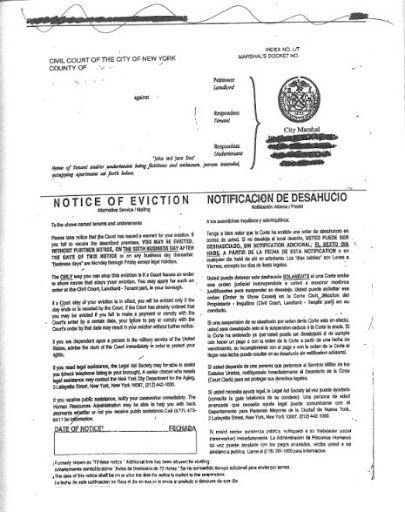
The marshal’s notice must contain your name, the marshal’s name, address, telephone number, and badge number; the name and county of the court; the title of the action, including the index number; the address of the premises, including a designation or description of the rooms or apartments concerned; a statement in bold type designating the notice as a notice of eviction; the date of the notice. If your name is not the the notice you cannot be evicted.
How much notice will I get from the marshal?
Marshals must give you (14) fourteen days notice from when the notice is posted to when you are evicted.
How do I get the landlord to pay for illegally evicting me?
If the landlord (or your roommate or prime tenant) locked you out illegally and damaged, discarded, or destroyed your belongings, you can sue the person for damages. You can talk to an attorney in the Housing Court Help Center for help. You might have seek compensation in a different court (Small Claims Court, Civil Court, or Supreme Court, depending on the value of your losses and the situation).
Why do landlords usually threaten to illegally evict tenants?
In some cases, small landlords don’t even realize that they have to evict people through the courts. Simply telling your landlord that what they threatened to do is illegal will be enough to stop them from performing an illegal eviction. Your landlord probably doesn’t want to face criminal and civil penalties.
Sometimes landlords threaten illegal evictions to avoid the cost and hassle of starting a legal eviction case. Even if you may eventually be evicted through the courts (maybe because you have not paid your rent, or because you are in an unregulated apartment and are not covered by a lease) your landlord still must follow legal procedures to evict you.
Some landlords threaten illegal evictions as a strategy of pushing out rent-stabilized or rent-controlled tenants who have lower rents, so to re-rent the apartment to someone else who will pay much more money. Rent-stabilized and rent-controlled tenants have very strong rights under the law, so some landlords who have no legal means to end a tenancy will make empty threats, hoping the tenant will be scared into moving out.
Remember: all tenants who have lived somewhere at least 30 days or have ever had rent accepted have the right to be brought to court if the landlord wants to evict them. This means even if your lease has expired or you never had a lease, your landlord cannot simply lock you out of your apartment; they must bring you to court and obtain a judgement of possession and a warrant of eviction. This includes tenants who may be living in “illegal” apartments–their landlords cannot simply throw them out. If an apartment is considered unsafe or illegal to be used as a residence, only a city agency can make that determination. All tenants have mechanisms to delay or even stop their evictions.
Legal Disclaimer
The information contained on this web page does not constitute legal advice and must not be used as a substitute for the advice of a lawyer qualified to give advice on legal issues pertaining to housing. For more, visit our page on Finding a lawyer.
This information pertains only to tenants living in New York City.
Many of your rights depend on the type of housing you live in or your type of tenancy. You may be subject to different laws and have different sets of rights than even neighbors in your own building. Learn which rights and responsibilities apply to you.
How to Handle Housing Court Without a Lawyer
It is generally a good idea to have an experienced tenant lawyer representing you on important housing matters such as evictions. However, many tenants cannot afford to hire a private lawyer, and getting free legal representation can be difficult, even for those who qualify. You can find a list of tenant only lawyers in the tab above.
- Learn the language. If you’re familiar with basic legal terms, you’ll be more informed and understand the lingo that’s likely to be used when your case is heard. “Pro se” means you’re representing yourself, for example. “Affidavit” is paperwork that verifies that you were served with court papers. A case that’s dismissed “without prejudice” can be brought again in the future; “with prejudice” means it can’t. You can learn more terms at the New York Courts web site, which has a Tenants’ Guide, as well as specific guides for Holdover and Nonpayment evictions in its Housing Court section.
- Start with how you were served with paperwork. There are specific rules that outline how you must be legally given the papers that summon you to court. If any of these were not followed, and you provide evidence for this, then your case can be thrown out just on that basis. That’s how my case was ultimately dismissed. Page 15 of the Housing Court tenants’ guide has more details.
- Use online resources to learn laws and see how cases like yours were won. You can go to sites like FindLaw to see the actual codes that dictate housing laws (for example, Section 7 of New York’s Real Property Law describes evictions, and Article 3 of New York’s Multiple Dwelling Law describes the tenants right to repairs). You can also use Findlaw’s case-law section to search for previous landlord-tenant cases in the city. The goal is to see how laws in the city have been previously translated and treated in similar cases as yours, and convince a judge that those same principles apply in your situation. By 2017, all of Harvard Law School’s national case law archives will be available online for free, too, which means everyday citizens have even more of an ability to knowledgeably cite historical judgments and apply them to their own cases.
- Use the other free resources available to you. Met Council’s free housing hotline is one fantastic resource, but we also offer a free in-person clinic for your questions on Tuesday evening, see here for more info. Housing Court Answers is another great way to get advice, either by telephone or at their tables in the courthouse, but prepare for a wait. Take thorough notes on every word of advice you get, because the details and legal language can be hard to follow and remember—but it’s those little details that can make the biggest difference in the outcome.
- Try to look like a lawyer. Everyone always tells you to dress neatly for court, but take a step further and dress like a lawyer. Think of what you’d wear to a job interview or an important business meeting, and show up in that. You’ll feel more confident in the courthouse, be perceived differently in others’ first impressions, and be treated more respectfully.
- Keep your cell phone off. Bring a book instead.
Once you find your case written on the board outside the Housing Part, take a seat on the bench in the room and don’t talk or pull out your phone. Not even if you see others doing it. It might be hours before your case is heard, and passing the time with a lit-up screen is likely to get you publicly scolded by court employees. Just pull out a book to pass the time.
- Learn the “adjourn.” I never actually met my landlord’s attorney in person, because he sent a colleague in his stead to adjourn nearly all of the cases. Indeed, the petitioner (who files the case) or the respondent (the other party) can reschedule, or “adjourn,” a court date if the suggested one doesn’t work for them, and this rescheduling can happen over and over again. It’s just painful for the respondent because you can spend many hours waiting in court, only to meet a lawyer who’s there only to request an adjournment. That means you have to come back on the later date and start it over again. If you’re representing yourself, this can get tedious, especially when you must miss work.
- Don’t take “tenant friendly” too literally. Yes, judges often rule in favor of tenants because there is justice in the world, and they may have real human empathy for someone unfairly losing their home. But this by no means creates a “friendly,” amiable environment. In my experience, court clerks and other employees often come off as abrasive, exasperated, and unhelpful in responding to questions, and you will likely have many. Psychologically, this feels belittling, especially when you see the friendliness between them and the attorneys who know them well. Remember, attorneys who specialize in this area are in the courthouse just about every day. Don’t take cold attitudes or short tempers personally; the courts are very, very busy.
- Don’t be intimidated.
The paperwork from an opposing attorney is scary—opening a new envelope addressed from them or finding papers plastered to your front door is heart-racing, no matter your experience. But remember that lawyers are busy people, and that means they can make mistakes. By doing my own online research using the above resources, I found that my landlord’s attorney had made several errors in their paperwork that could get their case tossed out. I also had handy a number of city codes and previous court cases that demonstrated that the accusations against me weren’t legally founded. Knowledge is power here. You need not have passed the bar exam to understand your legal rights.
- Don’t give up. I spoke to many friends, colleagues, and acquaintances who saw how my court battle was eating so much of my time and emotions, and they often told me that my apartment wasn’t ultimately worth the cost. But when you value your home and your stability, or can’t afford to move, it may just pay off in the end to fight.
There is a long history of landlords bringing charges unfairly against tenants and making unfounded, illegal threats of eviction. It’s on us to end those patterns and insist on justice. Know your rights.
This article was adapted from an article by Angela Pham, a Met Council hotline volunteer and member
Legal Disclaimer
The information contained on this web page does not constitute legal advice and must not be used as a substitute for the advice of a lawyer qualified to give advice on legal issues pertaining to housing. For more, visit our page on Finding a lawyer.
This information pertains only to tenants living in New York City.
Many of your rights depend on the type of housing you live in or your type of tenancy. You may be subject to different laws and have different sets of rights than even neighbors in your own building. Learn which rights and responsibilities apply to you.
What Are My Protections
What Are My Rights
Sample Letter
Good Cause Eviction
What apartments are covered by Good Cause Protections?
If you meet all the conditions below, you may be eligible for “good cause protections”:
- You do not live in a co-op or condo.
- You are not rent-regulated.
- Your landlord must own more than ten (10) units. If your landlord lives in your building and your building is ten units or less you are not covered. You can find out how many units your landlord owns here.
- Your rent is under 245% of the Fair Market Rate by HUD.
- Studio: $5,846
- 1 BR: $6,005
- 2 BR: $6,742
- 3 BR: $8,413
- 4 BR: $9,065
- Your building was built before 2009.
- Your apartment is not part of an employment agreement.
There is no directory of what buildings are covered by Good Cause Protections. Starting on August 20, 2024, Landlords must provide a notice at lease signing, renewal leases/rent hikes, a notice of evictions, and petition papers stating why Good Cause does not cover them.
If a landlord fails to provide necessary notice, eviction cases may be thrown out in court.
How can I find out how many units my landlord owns?
Starting August 20, 2024, your landlord will be required to tell you if he is claiming to be exempt due to number of units they own. Also if your landlord brings you to court and claims to be exempt, the LLC will have to give you the name of everyone who is an owner through the LLC, how many units they own and the addresses of those units.
Due to buildings being owned by limited liability corporations (LLC). It can be complicated to know how many units your landlord owns. One place to start is by searching your building on https://whoownswhat.justfix.nyc/
What rights and protections do with Good Cause Protections?
Good cause protection is a defense in a housing court case. If you meet all the conditions on the previous above, you have the following defenses in court:
- Rent increases are limited to 5%+CPI or 10%, whichever is less. The current amount is 8.82%. Housing and Community Renewal (HCR), the state housing agency, will announce it every August.
- Your landlord can only evict you for the following reasons:
- Non-payment of rent
- Violating a term of the lease
- Nuisance or illegal activity
- Failure to sign a lease renewal
- Failure to provide reasonable access to your apartment for repairs or for your landlord to show the apartment for rent or sale.
- Landlord taking over for personal use
- Landlord taking the apt off the market
- Demolition of the building
This protection does not include tenants with cases that were begun on or before April 20, 2024
How can my rent be raised within a Good Cause protected apartment?
Rent increases are limited to a flexible standard of 5%+CPI or 10%, whichever is less. The current amount as of April 2024 is 8.82%. Housing and Community Renewal (HCR), the state housing agency, will announce it every August.
What if my rent is raised more than the Good Cause flexible standard?
If your landlord raise your rent more than this years standard you can negotiate with your landlord or you can withhold part or all of your rent and use good cause as a defense in court. The court might find against you, if a landlord can show their costs have risen or if their have done significant repairs to the building.
Good Cause Eviction
On what grounds can I be evicted from a Good Cause protected apartment?
- Non-payment of rent
- Like any other tenant, as a rent-stabilized tenant, you can be sued for eviction in Housing Court if you owe back rent.
- Violating a substantial obligation of your lease.
Some examples include but are not limited to: - operating a business out of your apartment
- making alterations to your apartment without permission
- using appliances such as washing machines that are prohibited in your lease
- Failure to provide reasonable access to your apartment for repairs or for your landlord to show the apartment for rent or sale.
- Being a nuisance or illegal activity.
Examples include: - selling drugs
- constant noise coming from the apartment
- violent behavior
- cluttering your apartment to the point that it is a hazard
- paying your rent late on a chronic basis
- Limited landlord actions
- owner-use (the landlord is seeking the apartment for his/her personal use, or that of an family member)
- Landlord taking the apt off the market
- whole-building demolition
- Failure to sign a lease renewal
Do I need a lease to be covered under Good Cause?
No, you do not need a lease to be covered as long as your building meets the criteria to be covered.
What can I do if my landlord refuses to renew my lease or tries to evict when I am protected by Good Cause?
If your landlord refuses to renew your lease, tells you that you have to leave for a reason not listed above or no reason, or tries to evict you for no reason or for a reason not listed above, do not move. Tell your landlord, they need to give youa “Good Cause” to evict you. If your landlord then tries to formally evict you in court, you can raise a Good Cause defense.
April 22, 2026
Dear landlord,
I’m writing to you, to let you know that New York State passed Good Cause Eviction on April 20, 2024 and the law went into effect immediately. According to the law, the reasonable threshold for rent increases this year is 8.82%.
That percentage would increase my rent to ______.
Please adjust my lease accordingly and send me a new copy to sign.
Sincerely,
[Your name]
Unregulated Market
Rent Stabilized Renewals
Am I Rent Stabilized
Renewing your lease in an unregulated/ non-good cause (market-rate) apartment
Does my landlord have to offer me a renewal lease in a market-rate / unregulated apartment?
Your landlord is not required to offer you a renewal lease if you live in an unregulated / market-rate apartment. You may only renew your lease if your landlord agrees to do so.
If you want to remain, you can approach your landlord well before the expiration of your lease and ask to sign a new lease.
Your landlord may:
- offer you a renewal lease under the same terms, conditions, and rent levels;
- offer you a renewal lease, but change any of the terms and conditions, and/or the amount of rent;
- refuse to offer you a renewal lease, but permit you to continue living in the apartment without a lease as a month-to-month tenant; or
- refuse to offer you a renew lease, and ask you to leave the apartment
In market-rate / unregulated none good cause apartments, landlords do not need to have a reason to refuse to offer a renewal lease to an existing tenant.
Your landlord does not need to justify changes to the terms and conditions of a new lease, or reasons for raising the rent. This applies no matter your standing as a tenant, nor the length of time that you have lived there. (Issues of discrimination, and retaliation against tenants who complain about the lack of repairs or poor services, are addressed below in this information sheet.)
Legal Disclaimer:
The information contained on this web page does not constitute legal advice and must not be used as a substitute for the advice of a lawyer qualified to give advice on legal issues pertaining to housing. For more, visit our page on Finding a lawyer.
This information pertains only to tenants living in New York City.
Many of your rights depend on the type of housing you live in or your type of tenancy. You may be subject to different laws and have different sets of rights than even neighbors in your own building. Learn which rights and responsibilities apply to you.
If my lease expired and I was not given a renewal offer, can I keeping paying the same rent?
If you live in a market-rate / unregulated apartment, it’s important to clarify with your landlord happens when your lease ends. If you have not signed a new lease by the time your current lease expires, your landlord may expect you to leave – and may begin eviction proceedings at any point after the lease expires – if you have not moved out and returned possession of the apartment to your landlord (including by returning your keys). However, your landlord may be willing let you sign a new lease, or remain without any lease as a month-to-month tenant.
Tenants with leases have many more protections than those who don’t. However, tenants sometimes enter month-to-month arrangements when their landlord is unwilling to sign a new lease – or because the tenant prefers the flexibility of being able to move out on one month’s notice.
If your lease ends and you try to keep paying the rent but your landlord refuses to accept the rent, you are NOT in a month-to-month tenancy.
Your landlord may be preparing to start a court case to have you evicted.
If your lease ends and your landlord continues to accept your rent, you have entered into a month-to-month tenancy arrangement.
As a month-to-month tenant, every month that your landlord collects rent from you, he/she is accepting you as a tenant in that apartment for another month. However, your landlord may end the tenancy by giving you written notice. (If the notice is served in the middle of a month, it becomes effective at the end of the next full month.)
- If you have lived in the unit for a year or less, you must get 30 days notice.
- If you have lived in the unit for over a year and less then two years, you must get 60 days notice.
- If you have lived in the unit more then 2 years you must 90 days notice.
As a tenant you can also end a month-to-month tenancy by telling your landlord in writing that you intend to move out in 30 days. You must continue paying rent for the remainder of time that you live in the apartment. Your notice can cover any 30 day period.
My landlord refused to offer me a renewal lease (or the offer made to me was unreasonable or unaffordable) and gave me notice to leave. What will happen if I’m unable to move out by that date?
If your landlord does not renew your lease and you remain in the apartment, be prepared for your landlord to start an eviction case in housing court agasint you. The case will likely be a holdover case, meaning that your landlord is asking for the right to evict you even if you’re willing to pay the rent. For more, read our information sheet about holdover evictions.
To legally evict you, your landlord must take you to court, win a case against you and get judgment and a warrant before hiring a marshal to do the evictions. You have the right to defend yourself in the court case. It is illegal for your landlord, or someone hired by your landlord (other than a marshal) to remove you or your possessions, prevent you from entering your apartment, or discontinue essential services such as water, heat, or electricity. For more about this, read our information sheet on illegal evictions.
Once you are in housing court, you may be able to get additional time to find a new home before the court allows the marshal to perform the actual eviction. You could negotiate the terms of a move-out with your landlord in court and get that agreement signed, or you could explain to the judge that you need more time to find a new place to live. It is common for judges to give a month – or even a few months – for tenants to find a new apartment. If you don’t move out by that date, you may be able to request additional time from the judge. Usually tenans are ordered to continue paying the rent while they look for a new home, and in some cases judges may look favorably on long term tenants in good standing by granting additional time. However, the amount of time that judge can give you is limited. One year is the maximum amount of time allowed by law, and in many cases judges will be unwilling to give that amount of time.
If you are in a holdover case in an unregulated apartment, eventually you will have to move out or you will be evicted by a city marshal.
I believe that my landlord is refusing to renew my lease based on illegal discrimination. What can I do?
Contact the New York City Human Rights Commission regarding issues of illegal housing discrimination. You can reach the Human Rights Commission by calling 311 from a phone in New York City, or by calling 212-639-9675 from a phone outside of New York City.
I believe that my landlord is refusing to renew my lease in retaliation against me because I complained about services or repairs, or otherwise asserted my rights as a tenant under the law. What can I do?
Retaliation can be raised a defense in holdover eviction cases, but it can be difficult to prove. (Read our information sheet about holdover evictions.) Even if you are successful, the most that a housing court judge can award is the right to one renewal lease, but you cannot be awarded long-term rights to the apartment. Before pursuing this defense, you are strongly advised to discuss the situation with a lawyer.
How long do I have to decide whether to accept a landlord’s offer for a new or renewal lease in a market-rate apartment?
Unlike in the case of rent stabilized lease renewals where the law specifies how many days a tenant must be given to decide whether or not to accept or refuse a renewal lease offer, there is no set time frame for market-rate / unregulated tenants to respond. The first thing to do is check the offer and/or the renewal lease itself to see if they specifiy how long the offer is good for.
If neither the offer nor the lease agreement specify the duration of the offer, then principles of contract law govern.
“An offer that is not irrevocable does not stay open indefinitely. Although an offer does not specify the time by which acceptance must be made, the offer is deemed to be open and available to be accepted for a reasonable time unless sooner revoked. If such reasonable time has passed, the offer is deemed to have lapsed and cannot be accepted.” (New York Practice Series – New York Contract Law § 2:8).
The definition of ‘reasonable’ is not further defined in the law – only by precedent.
Can my landlord revoke his/her offer of a new lease or a renewal lease in a market-rate apartment?
Check the language of the lease and/or the offer. If there is language in the lease or the offer that indicates that it is irrevocable, the landlord cannot change his or her mind. Once the lease is signed by both parties, it becomes a binding agreement.
However, if your landlord has offered you a lease but has not signed it yet, and the lease or offer does not contain language saying that it is irrevocable, your landlord has the right to revoke the offer.
Can my landlord renew my lease without my consent?
In a market-rate apartment, if your lease contains an automatic renewal clause, your landlord must give you advance notice of the existence of this clause between 15 and 30 days before the date at which you are required to inform the landlord that you do not intend not to renew. (General Obligations Law §5-905)
If your lease does not contain an automatic renewal clause, your landlord is not allowed to renew your lease for another term without your permission. If you stay past the end of your lease and your landlord continues to accept rent from you, this does not mean that your lease has been renewed. It means that you have entered into a month-to-month tenancy arrangement (a type of tenancy that can be ended by either the tenant or the landlord upon 30/60/90 days notice.)
Rent Stabilized Lease Renewals
What are the current legal rent increases for rent-stabilized apartments?
For rent-stabilized leases being renewed between October 1, 2025 and September 30, 2026 the legal rent may be increased at the following levels: for a one-year renewal there is a 3% increase, or for a two-year renewal there is a 4.5% increase
To see the guidelines for previous years, refer to the chart of all Rent Guidelines Board orders from 1969 to 2020
Legal Disclaimer
The information contained on this web page does not constitute legal advice and must not be used as a substitute for the advice of a lawyer qualified to give advice on legal issues pertaining to housing. For more, visit our page on Finding a lawyer.
This information pertains only to tenants living in New York City.
Many of your rights depend on the type of housing you live in or your type of tenancy. You may be subject to different laws and have different sets of rights than even neighbors in your own building. Learn which rights and responsibilities apply to you.
Is my landlord required to renew my rent-stabilized lease?
If you live in a rent-stabilized apartment, you have the right under state law to renew your lease for a one or two year term, or to continue living in your apartment by the terms (including the rent level) of your old lease, until your landlord decides to offer you a lease renewal – with some exceptions.
To end your tenancy, your landlord must demonstrate that you have failed to pay the rent; violated a substantial term of your lease; violated something in the rent stabilization code; or have created a nuisance (or someone who lives with you has created a nuisance)
In some cases, a landlord may seek to terminate a tenancy based on the landlord’s intention to use an apartment for personal use or for the use of an immediate family member (owner-use) or because a landlord is seeking to demolish the building or convert it to non-residential use. (Tenants are encouraged to fight back, as there is a high burden of proof placed on landlords who seek to evict tenants on those grounds. Tenants threatened by this type of eviction are strongly encouraged to seek legal counsel.)
Your landlord’s failure to offer you a renewal lease for your rent stabilized apartment does not put you at risk of eviction. Your old lease and rent level stays in effect until your landlord properly offers you a renewal lease.
When is my landlord required to offer me a renewal lease for my rent stabilized apartment, and when am I required to return it?
If you live in a rent-stabilized apartment, your landlord is required to send a renewal lease offer between 90 and 150 days before your existing lease expires. You have 60 days to respond. You have the choice of renewing the lease for one or two years, or moving out and returning possession of the apartment to your landlord at the end of the lease.
You are strongly encouraged to photocopy your renewal lease and keep the copy for your records before you return the original. If the renewal lease was sent by mail, you are also strongly encouraged to keep the envelope it came in, as this may be your only proof of when the offer was sent. You may want to send your lease renewal to your landlord by certified mail, return receipt requested.
The law states that once you send your renewal lease in, your landlord must return a signed copy to you within 30 days, but some landlords ignore this rule. If that happens to you, you can file a complaint with DHCR by using Form RA-90 Tenant’s Complaint of Owner’s Failure to Renew Lease and/or Failure to Furnish a Copy of a Signed Lease. However, there is no statutory penalty for a landlord’s failure to return the signed copy of the lease. Once you have signed the renewal lease and sent it back to your landlord, the renewal is considered in effect, and it cannot be revoked. You should begin paying the rent increase when the renewal lease takes effect whether or not you have received a signed copy of the renewal lease from your landlord. Photocopying the lease with your signature before you mail it back to your landlord is useful in resolving disputes that may arise later.
I didn’t return my renewal lease within 60 days. What will happen to me?
If you wait longer than 60 days to return your rent-stabilized renewal lease renewal offer, your landlord may deem your lease renewed, and select a one- or two-year renewal for you. In this case, you will be liable for the rent for this new term. Their right to renew your lease comes from the rent stabilization code (Section 2523.5):
“Where the tenant fails to timely renew an expiring lease or rental agreement offered pursuant to this section, and remains in occupancy after expiration of the lease, such lease or rental agreement may be deemed to have been renewed upon the same terms and conditions, at the legal regulated rent, together with any guidelines adjustments that would have been applicable had the offer of a renewal lease been timely accepted. The effective date of the rent adjustment under the “deemed” renewal lease shall commence on the first rent payment date occurring no less than 90 days after such offer is made by the owner.”
Alternately, your landlord could begin an eviction proceeding against you in court after the lease expires, on the basis that you refused to sign a renewal lease. The courts may allow a late renewal if there is a reasonable excuse, but you are strongly encouraged to consult with an experienced tenant attorney in this situation.
I sometimes pay my rent late – will this affect my stabilized renewal lease?
Your landlord cannot refuse to offer a renewal lease on the basis that you are currently behind in your rent. You are entitled to a renewal lease even when you are in the middle of a nonpayment of rent eviction case in Housing Court. However, be advised that chronic late payment of rent is grounds for a landlord to begin a holdover eviction proceeding against a tenant – whether or not the tenant is behind in the rent at the time of the court case. For more on this, read our information sheet on holdover evictions.
My landlord has not sent my renewal lease – what should I do?
If your landlord does not offer you a renewal lease in the time-frame required by law, you are not in danger of facing an eviction for this, because your old lease remains in effect.
Your landlord’s failure to timely renew your lease may actually work out in your favor. The only thing that occurs upon lease renewal is that your landlord is entitled to raise your rent. The longer it takes for your landlord to offer a lease renewal, the longer it is before you need to pay a rent increase (at least 60 days after the offer) and you can refuse to sign any lease that is back-dated – instead demanding a lease with the proper start date.
Even though the failure to receive a renewal lease in a rent-stabilized apartment does not come witn any additional risks, some tenants feel more secure when they have signed a renewal lease. If you want to complain about your landlord’s failure to renew your lease, you can file a complaint with DHCR by using Form RA-90, Tenant’s Complaint of Owner’s Failure to Renew Lease and/or Failure to Furnish a Copy of a Signed Lease.
What can I do if the renewal lease for my rent-stabilized apartment has inaccuracies?
You can face serious consequences for signing lease renewals that contain invalid information. While your refusal to sign a valid renewal lease can be grounds for an eviction, there are many valid reasons you may want to refuse to sign a renewal lease offer, including:
- the renewal lease indicates a rent level that is illegally high
- the renewal lease changes the terms and conditions of your original lease
- your landlord back-dated the renewal lease, indicating either that it was presented to you earlier than it really was, or that the date the lease will take effect is less than 90 days after the renewal was offered
- the renewal lease improperly adds or omits names – or misspells names – of you or another primary tenant
- the renewal lease contains the name of a tenant who has moved or died, rather than the name of the family member who is claiming succession rights to the apartment
You can return the lease unsigned, send a letter explaining that you do want to renew a proper lease, but that this lease is invalid, and explain the reasons why it is invalid. Keep a copy of the letter you write. Also, photocopy the renewal lease before you return it, and keep the copy – as well as the envelope it came in (if the lease was offered by mail.) It’s advisable to send the invalid renewal lease to your landlord by certified mail, return receipt requested – and keep the certified mail receipt.
You may want to file a complaint with DHCR. You can use Form RA-90, Tenant’s Complaint of Owner’s Failure to Renew Lease and/or Failure to Furnish a Copy of a Signed Lease.
My landlord attached a rider to my rent-stabilized lease renewal. Do I have to sign it?
No – you can insist on your right to a lease renewal that has exactly the same conditions as your current lease (with only the amount of rent being adjusted according to permitted guidelines.)
Under Sec. 2523.5 of the Rent Stabilization Code, your landlord must offer to “renew the lease or rental agreement at the legal regulated rent permitted for such renewal lease and otherwise on the same terms and conditions as the expiring lease.”
In most instances, lease riders are unfavorable to tenants – in some cases, dramatically so.
In these situations, you can sign the lease but leave the riders to the lease unsigned and put a large “X” across the entire page of the lease riders. Alternatively, you can send everything back to your landlord and demand a renewal lease that does not contain any riders. For clarity, you may want to write a letter, and keep a copy for your records, stating that you are renewing your lease but not consenting to the attached riders. Photocopy the lease renewal and riders, and keep the copies for your records.
My landlord sent my rent stabilized lease renewal late, and then back-dated it. What can I do?
Your renewal lease should not take effect until a minimum of 90 days after it is offered. When landlords forget to offer leases at least 90 days prior to the expiration of the current lease, they forgo the right to raise the rent as soon as the law allows. Often landlords try to undo the mistake by back-dating the renewal offer, or by making the effective start date fewer than 90 days in the future.
You are not obligated to sign a renewal lease that has been back-dated, or which has a start date fewer than 90 days from when you receive it.
You can return the lease unsigned, send a letter explaining that you do want to renew a proper lease, but that this lease is invalid, and explain the reasons why it is invalid. Keep a copy of the letter you write. Also, photocopy the renewal lease before you return it, and keep the copy – as well as the envelope it came in (if the lease was offered by mail.) It’s advisable to send the invalid renewal lease to your landlord by certified mail, return receipt requested – and keep the certified mail receipt.You may want to file a complaint with DHCR. You can use Form RA-90, Tenant’s Complaint of Owner’s Failure to Renew Lease and/or Failure to Furnish a Copy of a Signed Lease.
My landlord sent an incorrect/improper renewal lease, and after I complained, I was sent a proper renewal lease. Does the rent increase take effect 90 days after the first renewal was offered, or 90 days after the first PROPER renewal was sent?
The renewal takes effect 90 days after the first proper lease renewal was sent. If you reject an improper lease, you are advised to keep a copy of the improper lease – and the envelope it came in to prove the date of delivery – and to send a written explanation identifying the problems with the lease to your landlord, mailed certified mail, return receipt requested.
I informed my landlord that I do not want to renew my rent-stabilized lease, but now I changed my mind, what can I do?
Consult an experienced tenant attorney. See our information sheet on finding a lawyer.
Is my landlord entitled to raise the rent of my rent-stabilized apartment without sending me a lease renewal?
No – to be eligible for a rent increase, including those approved by the Rent Guidelines Board, your landlord must offer you a renewal lease.
Exceptions apply if your landlord is granted a Major Capital Improvement rent increase from HCR, or if your landlord performs an Individual Apartment Improvement in your unit. Those rent increases may take effect during a lease.
My landlord attached a rider asking me to provide additional personal information. Do I have to provide this information?
No – you are not required to provide any additional personal information to your landlord, and your landlord cannot refuse to offer you a renewal lease or move to end your tenancy based on your refusal to do so. Threats that your lease-renewal will not be processed unless you provide this additional information are void as against public policy. If your landlord asks who lives in your apartment, you are not required to indicate anything more than the name of any family members or roommate who live with you.
Generally, it is not in the best interest of tenants to provide information beyond the names of the apartment occupants. Landlords usually want this information in order to search public records or to aid a private investigator in their search for reasons why they can start eviction proceedings against you.
If your landlord, for example, did not ask you for your social security number before you moved in, you are not required to provide this information later. You also do not need to verify your income, source of income, or your credit-worthiness. In any circumstance, your landlord is not permitted to perform a credit check without your written consent.
Can I add my spouse’s name to the lease when I renew the lease?
Yes. If the apartment is rent-stabilized, you can ask your landlord to add your spouse to the lease at any time. You do not have to wait for lease-renewal time. Simply write a letter to your landlord asking that your spouse be added to the lease, and send the letter by certified mail, return receipt requested, Your landlord is not entitled to charge you a rent increase for this. You can include a copy of the marriage certificate if your landlord asks for proof.
If your landlord refuses, you can file a complaint with New York State Homes and Community Renewal using Form RA-90, Tenant’s Complaint of Owner’s Failure to Renew Lease and/or Failure to Furnish a Copy of a Signed Lease, or simply keep a copy of the letter with proof of mailing for future use. The Rent Stabilization Code states that a tenant “shall have the right to have his or her spouse, whether husband or wife, added to the lease or any renewal thereof as an additional tenant where said spouse resides in the housing accommodation as his or her primary residence.”
How Can I Find Out If I Am Rent Stabilized?
What apartments are rent-stabilized?
Rent-stabilization applies to buildings that
- are privately-owned
- were built and occupied prior to 1974
- had at least six individual apartments in 1974 (even if there are fewer now)
Rent-stabilization also covers some new buildlings, when the landlord voluntarily entered the building into rent-stabilization in order to receive tax abatements.
Rent-stabilization does not apply if:
- you live in public housing, or your building is owned by a non-profit (including HUD-subsidized)
- your building was built or occupied after January 1, 1974 (unless your landlord voluntarily entered the rent-stabilization program)
- the building contained fewer than 6 units on January 1, 1974
- you moved into your apartment after the building converted into a co-op or condo
- If before June 2019 – your apartment was deregulated due to high-rent vacancy decontrol, or high-rent/high-income decontrol. (Note: landlords often claim that apartments were deregulated it was not legal for them to do so.)
What does it mean to be rent-stabilized?
Rent stabilization is a state housing law. There are 1 million rent-stabilized apartments In NYC, Westchester, Rockland, and Nassau counties. Rent Stabilization applies to buildings built before 1974 with 6 or more apartments. Starting in June 2019 any municipality can opt in to be covered by the state law, assuming they meet a couple of specific requirements.
Rent stabilization means your rent increases are determined by the Rent Guidelines Board (Appointed by the Mayor) & that they landlord must renew your lease
How do I know I’m rent stabilized?
While it’s not a guarantee, a good signal that you are rent-stabilized is:
- Your building has at least six apartments, and was built before 1974.
- Your rent is an unusual number – for example: $1187.59, rather than a round number like $1,200. Rent-stabilized apartments can only go up a certain percentage every year, causing the maximum legal rent to quickly become unusual.
- You sign a one-year or two-year lease renewal, and your rent goes up by a certain percentage.
- For a one-year lease commencing on or after October 1, 2025 and on or before September 30, 2026: 3%
- For a two-year lease commencing on or after October 1, 2025 and on or before September 30, 2026: 4.5%
- People in your building pay different amounts of rent for apartments that are similar in size.
It seems like my apartment should be rent stabilized, but my lease says that it is not. What’s the deal?
It’s possible that your landlord is claiming that your apartment is not rent-stabilized, even though it should be. The first thing to find out is whether your landlord has been registering your apartment as rent-stabilized with the New York State Homes & Community Renewal (HCR) – see below for information about getting your rent history.) Get a copy of your apartment’s rent history from the DHCR by texting “MCH” to (855) 610-2450 and following the prompts.
What is a rent overcharge?
There is a maximum legal rent for each apartment, based on the unique history of that apartment. It’s not based on the apartment’s size, nor the going rent of apartments in that area, nor the income of the tenant. Rents can be increased by small amounts every time the lease is renewed, and by larger amounts every time there is a new tenant or the apartment is renovated.
To find out the legal rent for your apartment, start by asking the New York State Homes and Community Renewal (HCR). That is the state agency in charge of overseeing rent-regulated apartments. The agency does not check to find out if the landlord is charging the legal rent. It’s up to you as the tenant to find out.
How can I find out what the legal rent of my apartment should be?
Landlords of rent-stabilized buildings are required to register the rents they charge with the New York State Division of Housing and Community Renewal (DHCR). They may or may not be registering the correct amount, but the first thing you need to do is find out what they have registered.
Get a copy of your apartment’s rent history from the DHCR by texting “MCH” to (855) 610-2450 and following the prompts.
Look at your rent history. It will show the registered rents for your apartment going back to 1984. (The registration may be missing for certain years.)
If you moved into your apartment less than four years ago, you may be able to challenge the legal rent for your apartment. If the previous tenant was paying much less than you are, it may be worth a closer look – for example, if the last tenant was paying $600, and your first rent was $1,100.
Landlords automatically get to raise rents 20% when a new tenant moves in. So if the tenant before you paid $750 per month, the landlord is automatically allowed charge you $900. Landlords also get to raise rents a certain percentage if they make renovations to the apartment. If they make $10,000 of repairs, they may be able to raise the rent by $250 per month. Sometimes landlords claim that they did renovations when they actually did not. A sudden jump in the rent could be an indication of an illegal rent increase – you’ll have to do further research in order to find out.
What can I do if I think I am being overcharged?
You may want to talk to a lawyer about your options. Getting free legal representation can be difficult, but you can always start at the Bronx Housing Court’s Resource Room on the 2nd floor on room 250. If you can’t get a lawyer, you may want to get the help of an advocate who works for one of your local elected officials, like your City Councilmember, State Assemblymember, or State Senator. Find out who your elected officials are by calling 311.
If you’re going to be in court before you have a chance to talk with a lawyer or advocate, you may want to ask for an adjournment – which means that you’re asking to re-schedule your court date – in order to get more time to look into the matter.
Two options – choose carefully:
There are two ways to challenge your rent, and the better option is not always the same for each tenant. You may want to consult a lawyer about which option is better for you.
- You may be able to raise the issue of an overcharge as a defense in your housing court eviction case.
- You can also challenge your legal rent through DHCR by filing form RA-89 “Tenant’s Complaint of Rent and/or Other Specific Overcharges in Rent Stabilized Apartments”. The DHCR form is available at DHCR offices, on DHCR’s website